


ESG Results 2024
ENVIRONMENT
Climate and Environmental Conditions
Energy and Resources
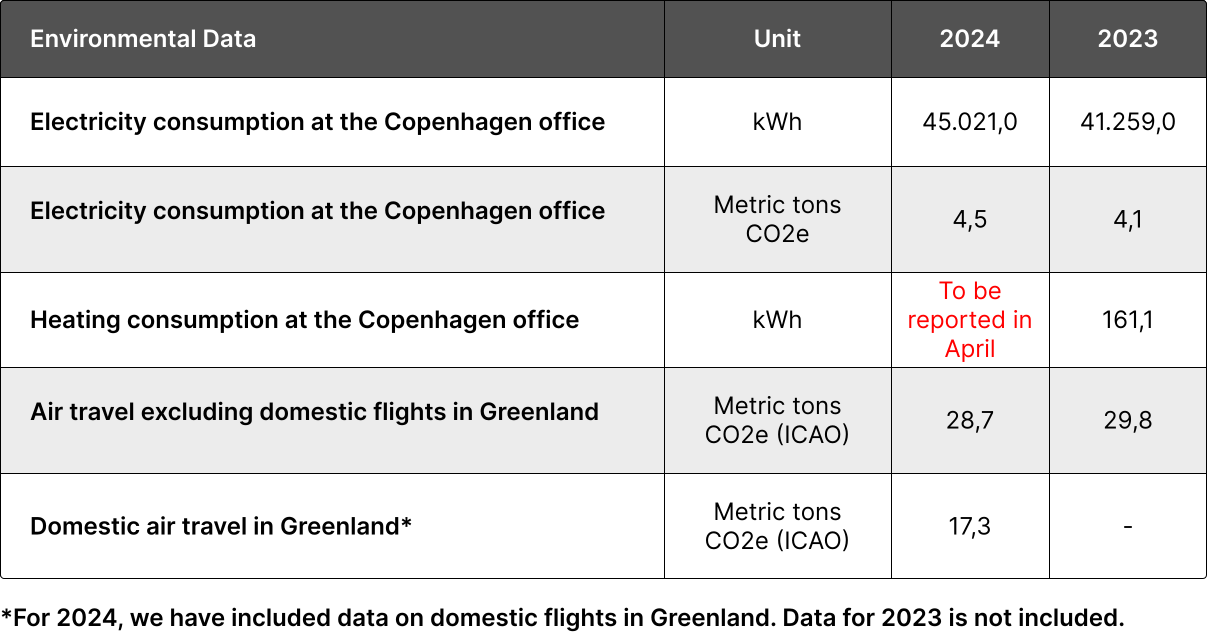
We are working to reduce our consumption of heating and electricity wherever possible. Through small internal awareness campaigns, employees are encouraged to save energy. UNICEF Denmark also offers employees a lunch program that includes many vegetarian options, is over 50% organic, and follows seasonal ingredients. The lunch provider reports that waste is sorted, and all ingredients are used as efficiently as possible to avoid food waste.
We follow the municipality’s waste sorting regulations for businesses, and sorting bins for cardboard, paper, plastic, metal, and deposit-return items are available in central areas of the office.
The office has also partnered with an organic coffee supplier to establish an initiative for reusing coffee grounds, ensuring that nothing goes to waste.

Procurement Policy and Certifications
In 2024, we introduced a procurement policy that requires suppliers to comply with the international labor standards of the International Labour Organization (ILO), which is the UN agency for labor issues. We are continuing to implement this policy across all purchases related to office operations (IT, equipment, furnishings, and services).
We reach out to our supporters both digitally and by mail.
When we send letters, they are printed on recycled paper, and in 2024, a total of 200,000 letters were sent.


Travel Activity
UNICEF Denmark operates in both Denmark and Greenland, and as part of an international organization, travel activities are necessary. A large part of our work involves maintaining relationships and building cooperation around the world, making travel an essential part of our value-creating efforts.
In Greenland, there are no roads between towns, so flights are required for activities and projects across locations. However, as part of a global organization, we frequently opt for online meetings instead of flying. To illustrate the environmental impact of our air travel, we collect data on our CO₂e emissions. For 2024, this includes data on domestic flights within Greenland. The methodology behind the reported figures is based on the UN’s International Civil Aviation Organization (ICAO).
UNICEF globally
Emergency aid is transported by truck, ship, and plane, and although CO₂e emissions are inevitable, UNICEF has taken significant global steps toward increased sustainability. UNICEF’s commitment to addressing planetary crises and moving the world toward carbon neutrality begins internally – with accelerated efforts to reduce greenhouse gas (GHG) emissions and environmental impact, and to prevent pollution, waste, and negative effects on biodiversity and ecosystems.
The scope and reach of UNICEF’s operations – spanning over 190 countries and territories worldwide – provide a unique platform for promoting sustainability and climate action across our facilities, operations, workplace policies, and our ability to influence the behavior of our own staff and our global network of partners and suppliers.

SOCIAL
Social conditions

A Work Life in Balance
To ensure a balanced work life with flexibility, employees are allowed to attend medical appointments and similar obligations during working hours. Additionally, there is an agreement allowing for two remote work days per week, provided the nature of the work permits it. In connection with parental leave, we offer 26 weeks of paid leave regardless of gender, as well as four weeks of pregnancy leave. All employees are also covered by a health insurance plan.
In 2025, a new workplace agreement will take effect, which includes two additional weeks of pregnancy leave, one extra week of parental leave, a 1% increase in employer-paid pension contribution, and a flexible employee co-payment option for pensions.
Each year, employees have the opportunity to participate in activities such as “We Bike to Work” and the “DBU Sponsor Cup.” In 2024, UNICEF Denmark staff also took part in the UN’s International Day of Play, where two hours of working time were dedicated to play. Additionally, we offer a massage scheme with employer-subsidized support and weekly meditation sessions during working hours for those interested.
We monitor employee well-being through regular pulse surveys, and in 2024, we continued offering debriefing sessions after crisis interventions. This initiative was introduced during our Gaza response, where the nature of images and stories had an emotional impact that required shared reflection and support.


Competence Development
We aim to ensure the best possible development for all employees, strengthening their ability to carry out their tasks and preparing them for potential new responsibilities. Employees across the organization have participated in relevant continuing education, with a particular focus in 2024 on upskilling the organization’s leaders through further training – specifically to equip them with the right tools to foster employee well-being.
Staff members also have the opportunity to undertake short-term work placements at other UNICEF offices around the world.
In 2024, one employee from the Copenhagen office completed a three-month placement at UNICEF’s office in South Sudan.
My time in South Sudan was a wonderful and deeply enriching experience. It pushed me well beyond (what used to be) my comfort zone, both in terms of navigating the context and filling my role. I gained invaluable insights into the complexities of operating in a humanitarian environment and learned about the importance and challenges of integrated sustainable solutions – all whilst witnessing the tireless dedication of UNICEF colleagues. I return to Denmark with renewed inspiration and a deeper understanding of the critical work we do for children.


Societal Impact
In a time marked by ongoing crises and disasters, we remain committed to holding on to hope. Our future has not yet been written, and despite prolonged wars, a changing climate, and shifting geopolitics, there is still much we can do to ensure a better future for the world’s children.
The societal impact we create together happens close to home in Greenland and Denmark. It also takes place in countries like Ethiopia, India, Brazil, and Ukraine through initiatives that provide, for example, emergency relief, clean water, vaccines, and access to education. These efforts play a crucial role in our mission to contribute to a more sustainable societal development for children worldwide and to address some of the most pressing global challenges.
Ataatsimoorluta Aalasa (Collective Movement) is a collaboration with GIF (Greenland’s Sports Federation), PAARISA (the Social Authority), and the Center for Public Health, aimed at creating safe and inclusive sports communities. UNICEF in Greenland contributes with guidance on the development of child perspectives and child policies – both nationally and within individual clubs.
UNICEF has also supported the establishment of a children’s council within GIF to ensure greater child participation in the clubs. This initiative also includes a collaboration with the police and the digitalization authority to create an easier digital solution for collecting child protection certificates.

UNICEF Child Rights Schools is a school concept based on the values of the UN Convention on the Rights of the Child, focusing on student well-being and participation. The schools’ Rights Councils, consisting of both children and adults from the school, work with support from UNICEF on issues of well-being and student influence, based on four perspectives: knowledge, learning, participation, and leadership.
In Denmark, we have 68 active Rights-Based Schools across 35 municipalities, reaching 32,000 students and around 3,000 educators and school leaders. The proportion of students in grades 4 to 9 who experience participation is 21% higher in Rights-Based Schools compared to similar non-Rights Schools. Knowledge of the Convention on the Rights of the Child is also significantly higher among children attending Rights-Based Schools.

Nearly half of Greenland’s schools (33 out of 73) are NAKUUSAAQQAT schools. NAKUUSAAQQAT is a UNICEF concept involving rights-based student councils at individual schools. We support the schools with teaching materials, information, and concrete activities with students to ensure a high level of child participation. There is also a strong focus on developing child perspectives and school policies, while also increasing awareness of children’s rights among both children and adults.

UNICEF strongly advocates for greater child participation across all the arenas in which children live their lives. In 2024, a political agreement was reached to reform the Danish public school system, which, among other things, proposes changes to the subject curricula. These changes aim to involve students more actively in the planning, implementation, and development of their education. This reform followed active advocacy work from UNICEF, in close collaboration with the Danish School Student Union and the National Council for Children. The effort included a new analysis documenting students’ experiences of participation in education, as well as meetings with policymakers and civil servants.

In 2024, the Children’s New Year’s Speech was broadcast for the second year on TV 2, just before the Prime Minister’s New Years address. With this initiative, we aim to support the development of a society where children’s concerns, hopes, and dreams are respected and heard. A society where children are seen as equal citizens and are encouraged to take part in democratic dialogue. The initiative includes not only the televised speech but also freely accessible educational materials and a local speech track. In partnership with libraries and museums, this enables children and young people to deliver their own New Year’s speeches – to each other, their parents, and local decision-makers and politicians.

For nearly 15 years, UNICEF has developed and facilitated NAKUUSA (“let’s be strong together”) in Greenland in collaboration with Naalakkersuisut (the Government of Greenland). NAKUUSA includes Meeqqat Isummersorfii, a national panel of children aged 12 to 17. Children and young people from across the country are represented, giving them a strong voice and platform for child participation in Greenland.
Each year, a physical Children’s Summit is held, where Meeqqat Isummersorfii chooses the topic. Based on the summit, participants develop recommendations directed at politicians, adults in general, and other children and young people in Greenland. NAKUUSA has a strong and systematic focus on rights-based child participation, and all activities aim to promote children’s rights, give children and youth a voice, and support genuine child participation in a Greenlandic context.

GOVERNANCE
Managerial aspects

UNICEF Denmark’s Governance and Management
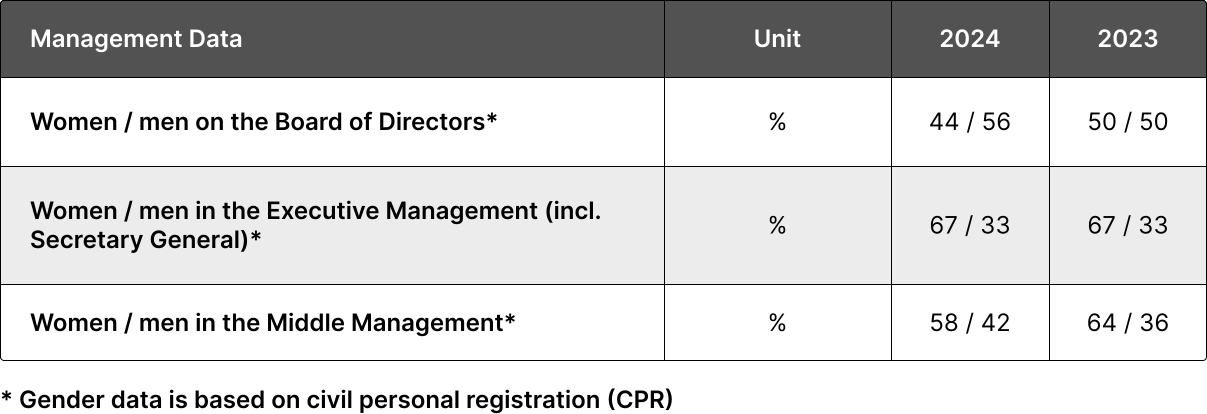
UNICEF Denmark is governed by a Board of Directors, which serves as the highest authority in accordance with the foundation’s purpose as outlined in its statutes. The board operates on a voluntary and unpaid basis, with members elected for two-year terms and a maximum tenure of six years. Each member contributes valuable knowledge and expertise to the leadership and development of our efforts to support the world’s most vulnerable children. Every year, the board evaluates its work and reviews the principles of good foundation governance.
The board has established three committees: the Audit and Risk Committee, the Innovation Committee, and the Nomination Committee, to ensure the board is composed of individuals with the necessary qualifications and experience to meet the organization’s needs.
UNICEF Denmark’s daily operations are led by five directors and the Secretary General. The five directorates are: Partnerships, Private Fundraising, Advocacy & Communication, Strategy & Operations, and Finance.
Child Safeguarding

Fundraising Ethics
IT Security, Awareness, and Critical Information
In 2024, UNICEF Denmark initiated efforts to uncover the most significant IT security challenges. Additionally, a new mandatory awareness training program was launched for all employees, focusing on IT security and GDPR.
We have a whistleblower system in place that allows both employees and external partners to report critical information confidentially. This ensures that we can respond immediately if any critical issues arise.
